Work Camp Project in Almería
SAWABONA is a word used by an African tribe to say 'I respect and esteem you. You are important to me.
The answer is: SHIKOBA which means 'I exist.' for you
Between 2 and 9 in Níjar, and from 20 and 29 in Roquetas de Mar. Alfonsina and Thelma, and Ximena respectively. They participated in a work camp in these towns of Almería, together with the “Friends of Africa” organization.
Work Camp in Almería: Nijar, first stop.
In Nijar, There are 16,803 Spaniards registered with 15,013 foreigners, the vast majority of whom will not have the right to vote in these elections, because they have the nationality of countries that have not signed a bilateral recognition agreement. This is the case of Morocco (10,160 registered, two out of every three foreigners) or Senegal (374).
The situation is reproduced in the rest of the province, whose greenhouses are nourished by immigrant labor.
We arrived in Almería on Friday. We have seen the two seas, the one of water and the one of plastic. Both stunning, bright and alive. One blue and one white
The first greenhouse was set up in Almería in 1963 as part of an experiment to improve agricultural yields. He promoted them the so-called National Institute of Colonization that would later become the Institute for Agrarian Reform and Development (IRYDA).
They were barely 100 m2. Since then, the area under plastics has not stopped growing and currently Almería has 33,000 hectares of greenhouses, according to data provided by the Junta de Andalucía in 2021. Most of them are located in El Ejido, followed by Níjar, Roquetas de Sea and Almería capital.
All of these greenhouses produce enormous quantities of fruits and vegetables that are exported or can be consumed in our country, all at very competitive prices. These productions generate a lot of work throughout the year, requiring an enormous amount of labor.
Bring some happiness Our life during that time was not about doing much, but rather being.
Work Camp in Almería: Roquetas de Mar, last stop.
En Roquetas de Mar We share life with the people who live in Las 200. Las 200 is a neighborhood with more than 8,000 people of more than 108 nationalities. Being the most multicultural in the area.
According to the mayor:
'It is a neighborhood that has attracted more immigrants than any other, but no more than the urban center of Roquetas, what happens is that it is more noticeable.'
This neighborhood, which was built to house about 200 families, is today home to more than 8,000 people from different countries. A coexistence that, according to many groups, is not easy. Currently, the census of people residing in Roquetas de Mar is 107,337 people on January 1, 2023, with an immigrant population of 33,064, which represents 30.8% of the residents.
Our days in Roquetas: In the mornings
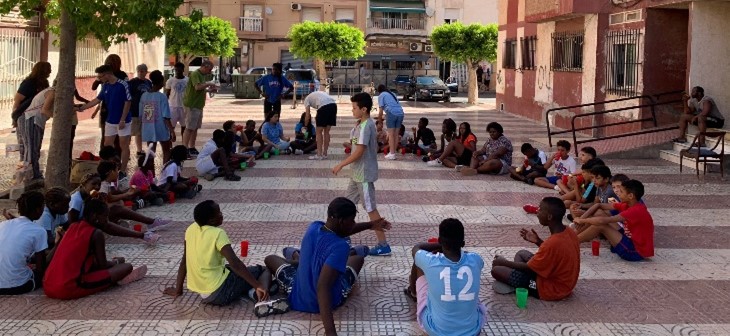
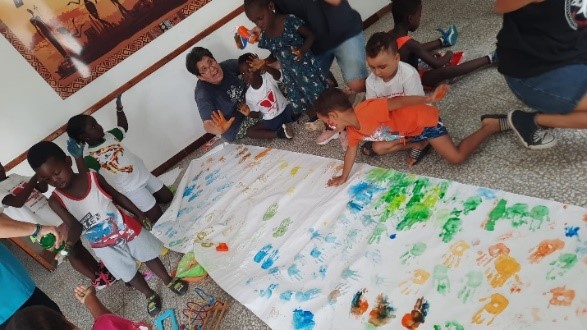
Our days in Roquetas, in the mornings we wanted to give a “mini-vacation” to the children and teenagers of the 200:
Games, drawings, paintings, face painting...
Breakfast and snacks…
In the evenings:
We gave training topics and testimonies to the 30 young people and adults who participated as animators of the Work Camp.
At night:
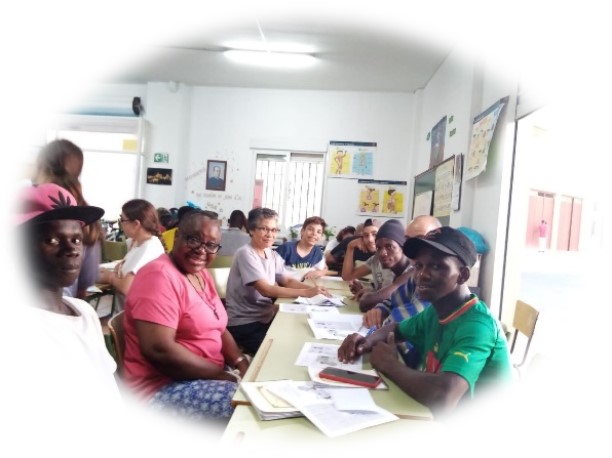
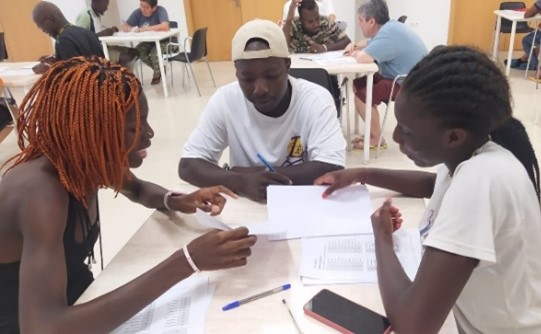
Literacy training for young immigrants, mostly sub-Saharans who during the day work in the greenhouses and who, after 3 years of staying in the place and knowing Spanish, can obtain regularization of their situation.
Once the day was over.
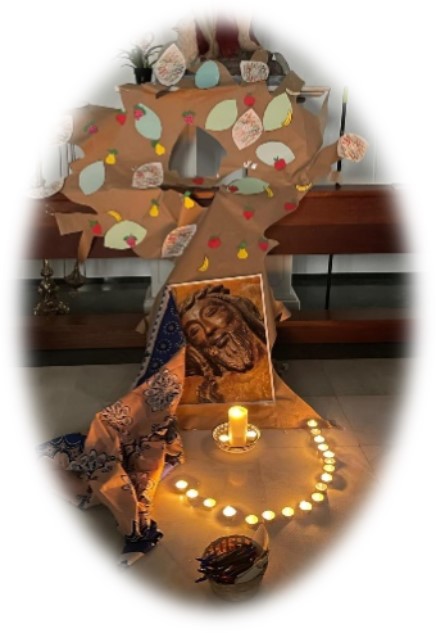
We gathered in the chapel to thank God for everything we had experienced, and especially for the people who helped us see life from another perspective.
An experience that marked us was the sign of washing each other's feet next to the Mediterranean Sea where so many of our brothers have lost their lives.